Case study 07
The first month operations reset
In one month, a team with no written procedures got 15 to 25 of them, one status standard on every board, a meeting pipeline that no longer drops calls in silence, an automated hours ledger, and a weekly client health page that leadership reads instead of builds.
When I arrived, recurring work lived in people's heads and in screen recordings. Status meant different things on different boards, and only about one in four tasks owned by leadership carried any status at all. An automation that turned meetings into tasks was missing most calls without raising an error. Recordings had stopped reaching the file store, and nobody owned that. Client hours were reconciled by hand from monthly exports, and recurring client reports from people who had moved on had no owner.
I built it in seven layers.
Visibility. A weekly team digest, a reminder engine, a daily task health report, and a short end of day note.
Standards. One status field, a comment line and a critical flag added to every board in a single day, a template board for new work, an automatic status sweep, and written task rules.
Pipelines. A daily end of shift audit of every recording (filed, indexed, turned into a task), an audit tracker, and rule fixes written up for whoever owned the automation.
Money and time. An automated client hours ledger, run beside the manual method until the two agreed, with each client's hours task updated weekly.
Client Hours Ledger, OVERVIEW tab
| Client | Purchased | Used | Balance |
|---|---|---|---|
| Alder | 120 | 47.50 | 72.50 |
| Basalt | 80 | 19.75 | 60.25 |
| Cedarline (flat fee) | 60 | 17.75 | 42.25 |
| Dolomite | 100 | 47.00 | 53.00 |
| Fernworth | 40 | 16.25 | 23.75 |
| Total, all 8 clients | 615 | 223.50 | 391.50 |
Task Health Dashboard, PERFORMANCE tab
| Owner | Open | Overdue | Closed | On time |
|---|---|---|---|---|
| Sarah Tellwick | 16 | 7 | 16 | 87.5% |
| David Rooker | 13 | 4 | 16 | 75.0% |
| Megan Fairhall | 11 | 3 | 16 | 75.0% |
| Chris Dunmore | 20 | 6 | 17 | 88.2% |
| Rachel Ostley | 28 | 8 | 15 | 93.3% |
| James Welford | 17 | 5 | 10 | 80.0% |
| Total (5 open have no owner) | 110 | 33 | 90 | 83.3% |
Knowledge. An SOP library on one approved template, a department taxonomy and an ID scheme, filled from walkthroughs as duties were handed over.
Reporting. An automated weekly one-page client health rating for leadership, with every reference linked.
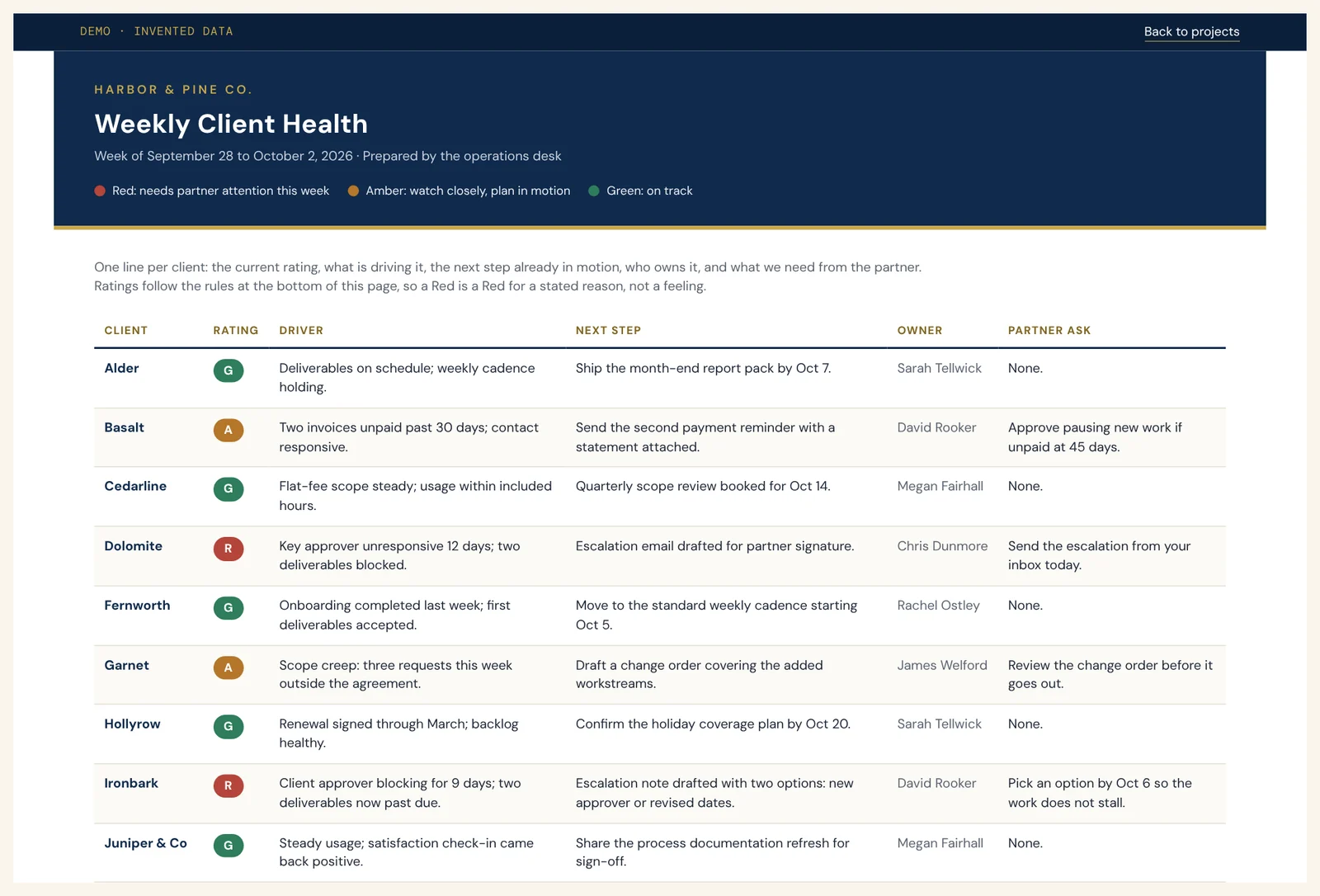
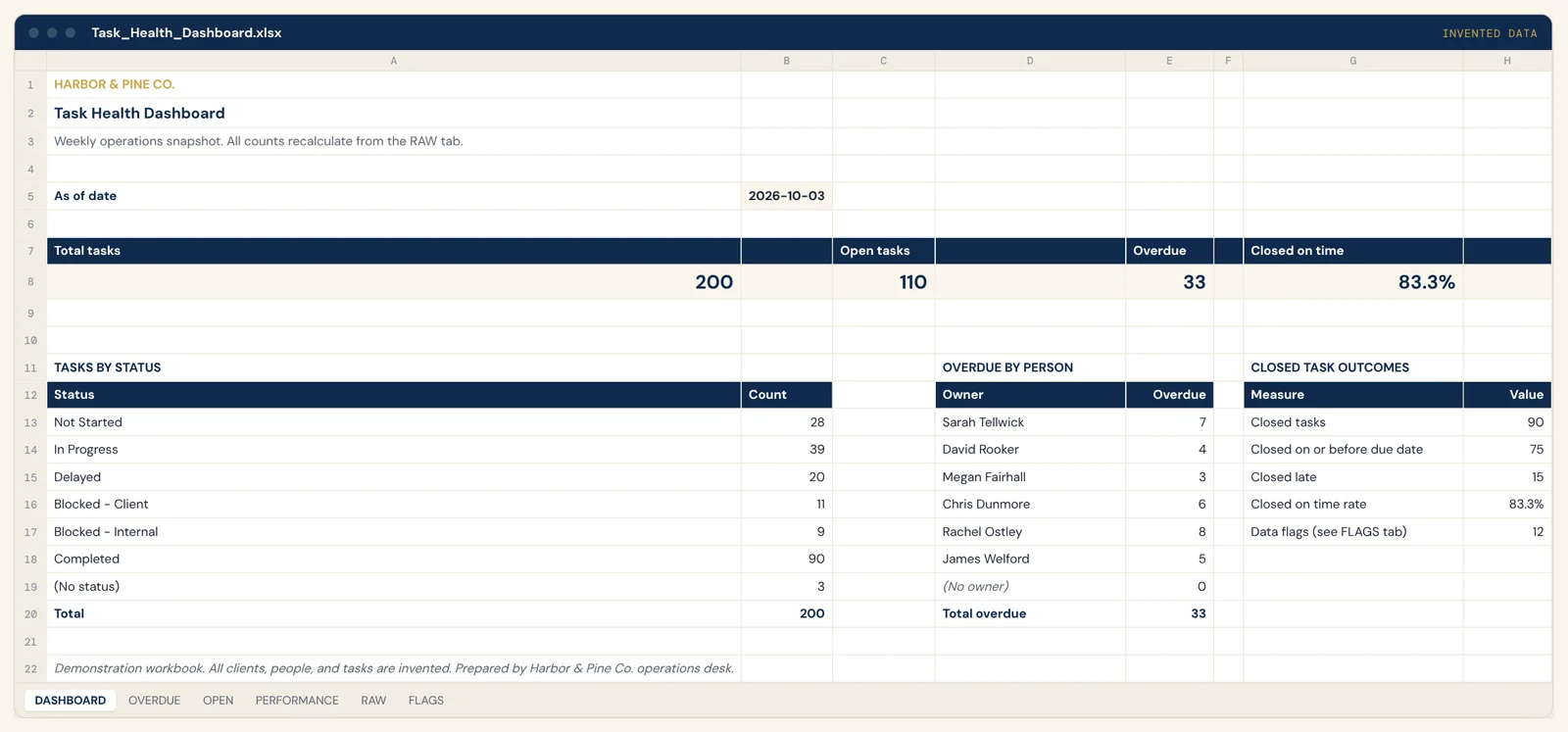
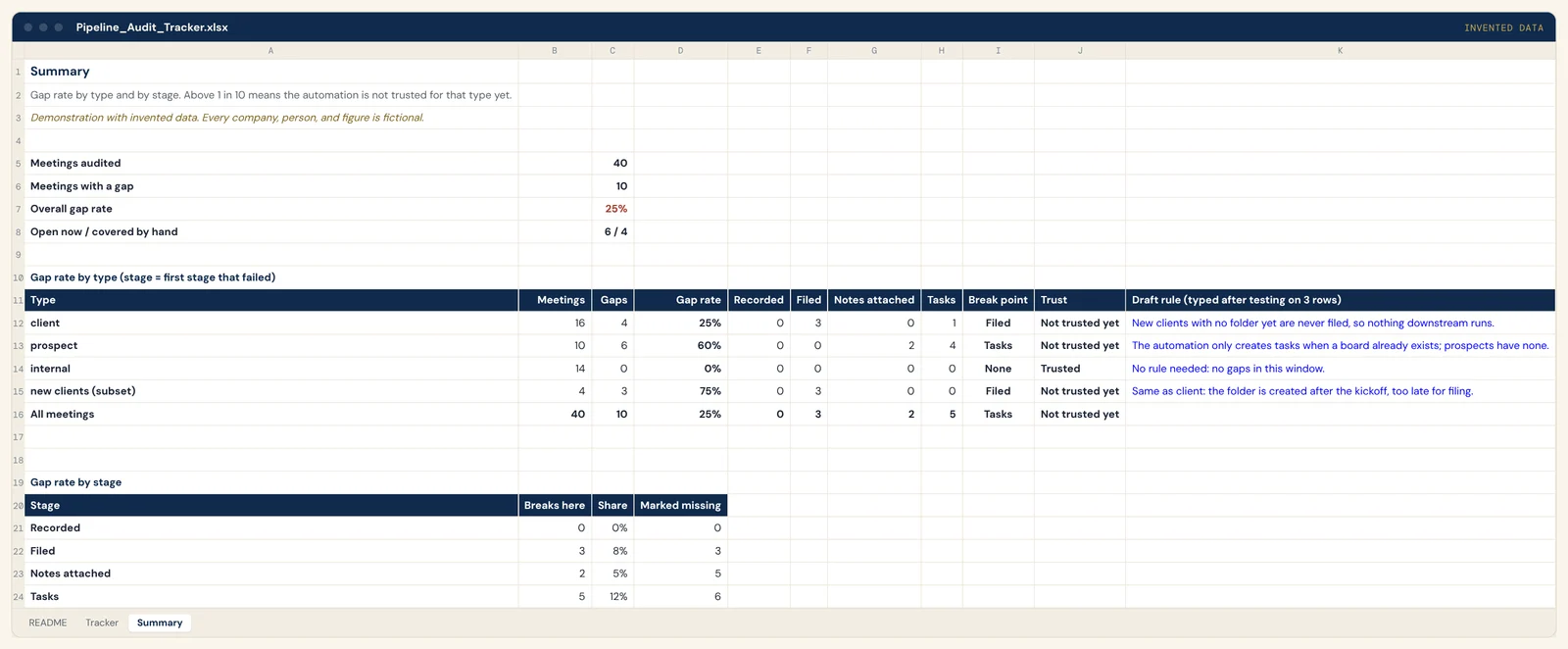
Click any image to see it full size. Every file here is rebuilt with invented data.
Client work taken over. Weekly and monthly client analytics, a month-end close, and a competitive price study.
The results, in bands. Status fields went onto every active board within one day, up from about a quarter of leadership tasks. A gap of about three in four client calls was found and covered the same day while the automation was fixed, and a few dozen missed tasks were backfilled. The weekly client health page became a scheduled send, and my part shrank to review. Monthly reshaping of hours became an automated weekly pull. The price study grew from a handful of seed rows to 100 to 150 checked rows across 30 to 40 competitors. Several inherited reports went out on schedule after handover, each with its own SOP.
Plenty, and each slip sits with the system it belongs to: the transcript filing in case study 08, the re-check rounds and the image slip in 09, the flipping test switch and the inbox clutter in 11.
Client Hours Ledger (demo workbook)Task Health Dashboard (demo workbook)Weekly Client Health (demo)Team Digest (demo)Live demos of the working filesThe Pipeline Gap AuditorThe Client Health RaterThe Retainer Hours Balance toolThe Audit playbook (PDF)The Price Check playbook (PDF)The Final Check playbook (PDF)